Nearshore Electronics Manufacturing: The Complete Guide for US OEMs

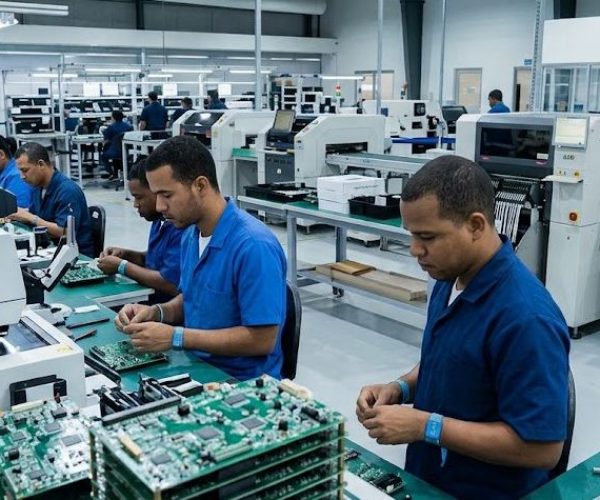
Technicians assembling printed circuit boards on an SMT production line in a nearshore electronics manufacturing facility.

Supply chain disruptions, geopolitical volatility, and high ocean freight fees have forced US Original Equipment Manufacturers (OEMs) to re-evaluate traditional transpacific sourcing. For decades, offshoring to Asia was the default choice for high-volume Electronics Manufacturing Services (EMS). Today, that model introduces significant operational exposure: 12-week shipping pipelines, unpredictable import tariffs, time-zone disconnects, and complex Intellectual Property (IP) risks.

Nearshore electronics manufacturing provides a faster, lower-risk strategic solution. By shifting assembly to neighboring countries within North American time zones, US OEMs maintain low labor costs while regaining supply chain velocity, agility, and direct engineering control.

This guide breaks down the financial and operational mechanics of nearshore EMS. It evaluates total cost of ownership (TCO) against Asian offshore models and explains how duty-free trade agreements make regional manufacturing the most resilient strategy for US OEMs.

What is Nearshore Electronics Manufacturing?

Nearshore electronics manufacturing is the practice of contracting Printed Circuit Board Assembly (PCBA), surface-mount technology (SMT), wire harness production, and full box-build assembly to a specialized supplier in a nearby country—typically within a 1-to-4-hour flight and a shared time zone with the US.

For US OEMs navigating volatile global trade policies, leveraging DR-CAFTA serves as a critical tariff safety valve against rising costs 

Core Comparison at a Glance:

  • Offshore EMS (Asia): 8–12 week ocean shipping | +12 to +15 hour time gap | Section 301 tariffs | Heavy capital tied up in buffer inventory.
  • Nearshore EMS (The Americas / DR): 2–5 day ocean/air freight | Direct EST time-zone overlap | 0% duty under DR-CAFTA | Lean working capital footprint.

Nearshore vs. Offshore Electronics Manufacturing

Evaluating manufacturing destinations solely on piece-part price creates a distorted financial picture. While Asian suppliers may offer lower nominal assembly labor rates, hidden pipeline expenses—such as sea freight, safety stock holding fees, tariff penalties, and emergency air freight—often eliminate those upfront savings. Eliminating transpacific transit delays provides a direct 2-day logistics advantage over traditional Asian supply chains. 

Metric / Operational Factor

Offshore Manufacturing (Asia / China)

Nearshore Manufacturing (Dominican Republic)

Strategic Impact for US OEMs

Standard Shipping Time

35 to 45 Days (Ocean Freight)

2 to 5 Days (Sea / Direct Port)

Reduces pipeline stock and speeds up customer delivery.

Emergency Logistics

5 to 7 Days (High Air Freight Cost)

24 to 48 Hours

Enables fast response to sudden demand spikes or engineering changes.

Time Zone Alignment

12 to 15 Hours Difference

0 to 1 Hour Difference (EST Overlap)

Allows real-time engineering calls and daily production reviews.

Customs Duties & Tariffs

Section 301 Tariffs (Up to 25%+)

0% Duty-Free under DR-CAFTA

Provides direct landed-cost savings on finished electronic assemblies.

IP Protection Framework

Complex, variable legal enforcement

Strict frameworks aligned with US laws

Protects against design copying and unauthorized production.

Working Capital Needs

2–3 months of buffer stock locked in transit

1–2 weeks of buffer stock required

Frees up cash flow and increases inventory turns.

NPI & Onsite Audits

24+ hours of travel time; high costs

Same-day or next-day travel

Speeds up New Product Introduction (NPI) cycles.

Why the Dominican Republic is a Leading Nearshore EMS Hub

While Mexico is a common nearshore option, border congestion, rising wage inflation, and labor instability have prompted major US electronics OEMs to seek stable alternatives.

The Dominican Republic has rapidly positioned itself as a primary Caribbean hub, expanding from standard assembly into specialized sectors like Semiconductor ATP and Packaging and High-Tech Electronics Export. 

Key Strategic Advantages of the Dominican Republic:

  • Direct Maritime Connections: Major deepwater facilities (including the Port of Caucedo and Rio Haina) route containerized cargo directly to South Florida ports in 3 days, providing rapid response times.
  • Dedicated Industrial Free Zones: Infrastructure within free trade zones—such as the San Pedro Industrial Free Zone—provides continuous grid power, high-speed fiber connectivity, secure facilities, and streamlined customs clearance.
  • Skilled Engineering Workforce: Technical institutes and universities across the DR graduate thousands of specialized engineers each year in mechatronics, systems, and industrial engineering, offering high labor stability and low turnover.
  • Working-Hour Synchronicity: Operating on Atlantic Standard Time (AST) which mirrors Eastern Standard Time (EST) for half the year and sits just 1 hour ahead during Daylight Saving Time, engineering teams collaborate during normal US business hours.

The DR-CAFTA Advantage: 0% Duty Electronics Sourcing

International trade policy directly influences landed product margins. The Dominican Republic-Central America Free Trade Agreement (DR-CAFTA) offers US companies a distinct financial edge over Asian manufacturing options.For US OEMs navigating volatile global trade policies, leveraging DR-CAFTA serves as a critical tariff safety valve against rising costs. 

Under DR-CAFTA rules of origin, eligible electronic assemblies, PCBAs, harnesses, and finished box-builds manufactured in the Dominican Republic enter the United States 100% duty-free.

Landed Cost Formula Comparison:

Offshore Sourcing (Asia): Unit Base Cost + Sea Freight + Import Duty + Up to 25% Sec 301 Tariff = Unpredictable Landed Cost & Margin Compression

Nearshore Sourcing (Dominican Republic): Unit Base Cost + Reduced Sea Freight + 0% DR-CAFTA Duty + 0% Tariff = Optimized, Predictable Landed Cost

Key Financial Gains of DR-CAFTA:

  1. Eliminates Tariff Penalties: Completely avoids the costly Section 301 tariffs frequently applied to Chinese components and assemblies.
  2. Accelerated Port Customs Clearance: Pre-cleared freight documentation between DR ports and US Customs speeds up shipment clearance, eliminating multi-week delays.
  3. Simplified Component Rules: Clear tariff shift rules allow US components to be exported to the DR for assembly and returned to the US without duplicate taxes or VAT penalties.

Proven Nearshore Production with Fenix Manufacturing Solutions

Selecting the right location is only half the strategy—execution requires an experienced, quality-focused manufacturing partner. Fenix Manufacturing Solutions is the largest electronics contract manufacturer operating in the Dominican Republic.

Operating out of the San Pedro Industrial Free Zone, Fenix serves as a reliable nearshore partner for US OEMs across critical sectors, including automotive, power management, lighting, consumer electronics, and communications.

Fenix Core Production Capabilities:

  • ISO Quality Management Systems: Certified operations enforcing total quality management compliant with global standards such as ISO 9001:2015, incorporating Automated Optical Inspection (AOI), In-Circuit Testing (ICT), and full functional testing.
  • Advanced PCBA & SMT Lines: Precision surface-mount, through-hole, and mixed-technology PCB assemblies, handling fine-pitch BGAs and complex multi-layer boards.
  • Full Box-Build & Harness Integration: Complete electromechanical integration, custom wire harness assembly, crimp force monitoring, and final box enclosure builds.
  • Early DFM & Engineering Support: Synchronous engineering reviews during the New Product Introduction (NPI) stage to lower production costs and increase yield before mass assembly starts.

Frequently Asked Questions

What is the main difference between reshoring and nearshoring?

Reshoring brings manufacturing completely back inside the home country (e.g., relocating production from Asia to the domestic US). Nearshoring relocates production to a nearby country within the same geographic region or time zone (e.g., shifting electronics assembly from Asia to the Dominican Republic). Nearshoring delivers labor cost savings while providing the speed and logistics control of domestic production.

How fast is transit time from the Dominican Republic to the US?

Standard ocean shipping from major Dominican ports (like Caucedo) to South Florida takes 3 days. For urgent orders, direct flights connect Santo Domingo to major US hubs in under 4 hours, enabling rapid turnaround.

Are products built in the Dominican Republic duty-free in the US?

Yes. Under DR-CAFTA, electronic components, wire harnesses, and finished assemblies built in the Dominican Republic that meet rule-of-origin guidelines enter the United States 100% duty-free.

Is Intellectual Property (IP) protected when manufacturing in the Dominican Republic?

Yes. The Dominican Republic enforces legal IP protections aligned with international standards under DR-CAFTA. Partnering with a US-headquartered manufacturer like Fenix ensures your proprietary designs, code, and trade secrets are fully protected under US contracts and legal agreements.

Strategic Internal Resources

To learn more about optimizing your nearshore supply chain, explore our specialized solutions:

en_USEN