Editar el contenido

Mantente en contacto

Estados Unidos

Fenix – USA
389 Palm Coast Parkway SW
Palm Coast, FL 32137
(803) 649-1381
info@fenix-mfg.com

República Dominicana

Fenix – DR
San Pedro Industrial Free Zone
San Pedro De Macorís, República Dominicana
(809) 529-4421
info@fenix-mfg.com

Plasma Etching in Electronics: Precision at the Microscopic Level

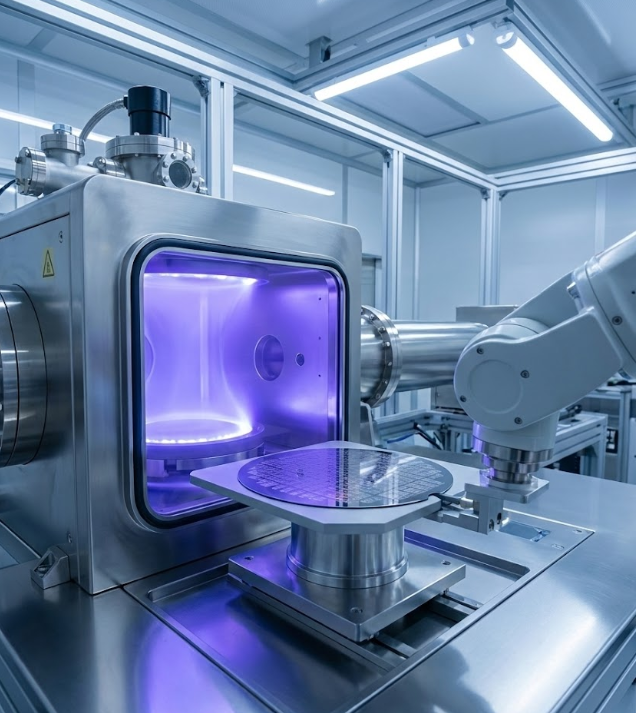
Primer plano del proceso de grabado por plasma (plasma etching) con luz violeta tratando la superficie de un PCB de alta densidad dentro de una cámara de vacío.

When it comes to manufacturing high-performance electronics, cleanliness is not just about appearance : it’s about microscopic perfection.
Every circuit board, connector, and sensor surface must be free from contaminants that can weaken adhesion, disrupt conductivity, or compromise reliability.

This is where the plasma etching process comes in, an invisible but essential step that defines the quality of modern electronics.

What Is Plasma Etching?

Plasma etching is a dry surface treatment technique that uses ionized gas (plasma) to clean, activate, or texture material surfaces.
Unlike chemical wet etching, plasma uses electrically energized particles to remove microscopic contaminants without liquid solvents or mechanical abrasion.

The Science in Brief:

When a gas such as oxygen or argon is energized in a vacuum chamber, it forms a plasma composed of ions, radicals, and electrons. These particles collide with the surface of the material, breaking molecular bonds and vaporizing contaminants or thin films with extreme molecular precision.

Key Advantages of Plasma Etching

  1. Microscopic Precision: Removes layers as thin as a few nanometers; ideal for semiconductors and fine PCB traces.
  2. Superior Adhesion: Prepares surfaces for coatings, solder masks, or bonding by activating chemical groups.
  3. Cleanroom Compatibility: Operates in controlled environments, eliminating the need for harsh chemicals.
  4. Material Versatility: Works on metals, ceramics, and polymers alike.

Eco-Friendly Process: Generates minimal waste and uses less water and chemical residue compared to wet methods.

Applications in Electronics Manufacturing

Stage

Function

Example

PCB Production

Surface activation for solder mask adhesion

Multilayer circuit boards

Semiconductor Fabrication

Selective etching of silicon layers

IC patterning

Plastic Component Preparation

Improves bonding for coating or printing

Connector housings

Medical Device Assembly

Enhances polymer adhesion and sterilization

Catheter electronics

Aerospace Electronics

Cleans critical surfaces before encapsulation

Sensor modules

Types of Plasma Etching Processes

  1. Reactive Ion Etching (RIE): Uses chemical and physical effects for ultra-fine patterning; common in semiconductor fabrication.
  2. Isotropic Etching: Removes material uniformly in all directions; used for surface cleaning.
  3. Anisotropic Etching: Removes material directionally, creating vertical sidewalls; ideal for micro-channels or MEMS devices.

Plasma Cleaning: A gentler process focusing on removing organics and improving surface energy.

Process Steps at Fenix MFG

  1. Load & Pre-Bake: Components are dried to remove moisture.
  2. Vacuum & Gas Introduction: A controlled mixture of gases (often oxygen or argon) is introduced.
  3. Plasma Ignition: High-frequency energy converts gas to plasma.
  4. Etching Cycle: Ions react with the surface for cleaning or activation.
  5. Post-Treatment Validation: Contact angle measurement and adhesion testing confirm surface readiness.

This repeatable, traceable process ensures consistent quality across every production batch.

Why Plasma Etching Matters for Fenix’s Clients

Fenix integrates plasma etching into multiple manufacturing steps, from PCB surface prep to electromechanical assemblies such as those involving Bobinado de alambre fino, to ensure every connection, coating, and adhesive bond achieves maximum performance.

Key Benefits for Partners:

  • Improved solder reliability
  • Longer coating adhesion
  • Enhanced bonding strength in multi-material assemblies
  • Reduction of field failures due to contamination

Innovation and Future Trends

  • AI-Driven Plasma Control: Real-time adjustments in gas flow and power for uniform etching.
  • Green Manufacturing: Transitioning to fluorine-free gases to reduce environmental impact.
  • Nanostructured Surfaces: Creating micro-textures for next-generation adhesion and heat dissipation.

Conclusion: The Surface of Perfection

From semiconductors to medical sensors, the success of advanced electronics begins at the surface.
Through plasma etching, Fenix MFG ensures that every microscopic detail meets the highest standards of cleanliness, adhesion, and reliability, because in precision manufacturing, perfection starts where the human eye can’t see.

FAQ: Plasma Etching

Q1: How is plasma etching different from chemical cleaning?
A: Plasma etching uses ionized gases, avoiding liquid chemicals, resulting in cleaner, more controlled surfaces.

Q2: What materials can be plasma treated?
A: Metals, ceramics, glass, and polymers; any material that benefits from better adhesion or surface activation.

Q3: Why is this process eco-friendly?
A: It minimizes chemical waste, water use, and energy consumption compared to traditional wet etching methods.

es_ESES