Medical Electronics Manufacturing: Why ISO 13485 is Just the Starting Line

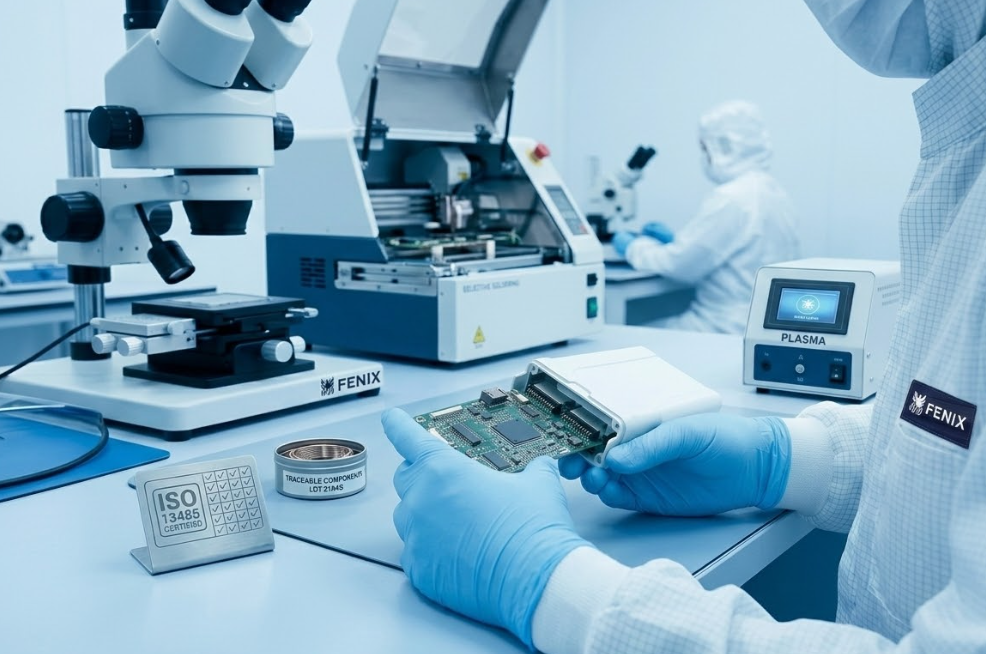
Close-up of a medical PCB assembly in a cleanroom with traceable components and ISO 13485 compliance tools at Fenix MFG.

In most industries, a defect is a warranty claim. In medical manufacturing, it is a patient safety issue.

For MedTech startups and established OEMs, the search for an Electronic Manufacturing Services (EMS) partner often starts with one checkbox: ISO 13485 Certification.

While this certification is mandatory, it verifies that a manufacturer has a quality management system capable of producing medical devices ; it is not the ceiling of quality. It is the floor.

At Fenix MFG, we believe that true reliability in medical electronics comes from what happens inside that framework: the culture of risk management, traceability, and microscopic cleanliness.

Traceability: The Digital Fingerprint

If a specific capacitor is found to be defective five years from now, can your manufacturer tell you exactly which patient monitors contain that specific batch?

For Fenix, the answer is yes.

We utilize component-level traceability. From the moment a reel of components enters our warehouse to the moment the final PCBA is shipped, every step is logged.

  • Why it matters: In the event of a recall, this precision allows you to isolate only the affected units, saving millions in costs and protecting your brand reputation.

Related: Gestión de calidad: la mejor herramienta para fidelizar a sus clientes

Risk Management (ISO 14971 Integration)

Medical manufacturing requires a defensive mindset. We don’t just ask “How do we build this?” We ask “What could go wrong?”

Our process engineers actively participate in PFMEA (Process Failure Mode and Effects Analysis). We look for potential failure points in the assembly process—like a solder bridge on a fine-pitch connector—and engineer controls to prevent them before production begins.

Cleanliness & Surface Integrity

Medical devices often require potting, coating, or specialized bonding. These chemical processes fail if the surface isn’t perfectly clean.

We employ advanced surface treatment technologies to ensure sterility and adhesion.

  • Plasma Treatment: We use plasma to remove organic contaminants at a molecular level, ensuring that conformal coatings adhere perfectly to the board, preventing delamination in humid hospital environments.

Deep Dive: Plasma Etching in Electronics: Precision at the Microscopic Level

Box Build for Medical Devices

Many medical OEMs prefer to keep their supply chain simple. Instead of moving a sensitive PCB to a generic assembly house, Fenix handles the complete Box Build.

We integrate the electronics into the medical-grade housing, install displays, and route cables, delivering a finished unit ready for final packaging.

Conclusion: A Partner for Patient Safety

Building electronics for the medical industry is a privilege that comes with heavy responsibility.

When you choose Fenix MFG, you aren’t just hiring a factory. You are partnering with a team that understands that behind every part number, there is a patient.

FAQ: Medical Manufacturing

Q: Is Fenix MFG ISO 13485 certified?

A: Yes, our facilities maintain strict ISO 13485 certification, ensuring our quality management systems meet the global regulatory requirements for medical devices.

Q: Can you support Class II and Class III medical devices?

A: We have extensive experience manufacturing Class I and Class II devices (such as diagnostic equipment and monitoring systems). For Class III (life-sustaining) devices, please contact our engineering team to review specific risk requirements.

Q: Do you offer Process Validation (IQ/OQ/PQ)?

A: Yes. For medical clients, we perform Installation Qualification (IQ), Operational Qualification (OQ), and Performance Qualification (PQ) to prove that our equipment and processes consistently produce parts that meet specifications.

es_ESES