Fenix – USA
389 Palm Coast Parkway SW
Palm Coast, FL 32137
(803) 649-1381
info@fenix-mfg.com
Fenix – DR
San Pedro Industrial Free Zone
San Pedro De Macorís, República Dominicana
(809) 529-4421
info@fenix-mfg.com
Fenix – USA
389 Palm Coast Parkway SW
Palm Coast, FL 32137
(803) 649-1381
info@fenix-mfg.com
Fenix – DR
San Pedro Industrial Free Zone
San Pedro De Macorís, República Dominicana
(809) 529-4421
info@fenix-mfg.com
The factory is a safe haven. The real world is a battlefield.
Inside Fenix MFG’s production floor, humidity, temperature, and static electricity are strictly controlled. But once a product ships, it might end up under the hood of a car, inside a marine sensor, or powering a medical device in a humid hospital ward.
For OEMs in high-reliability sectors like Automotor and Industrial Controls, the question isn’t if the environment will attack the electronics, but how to stop it.
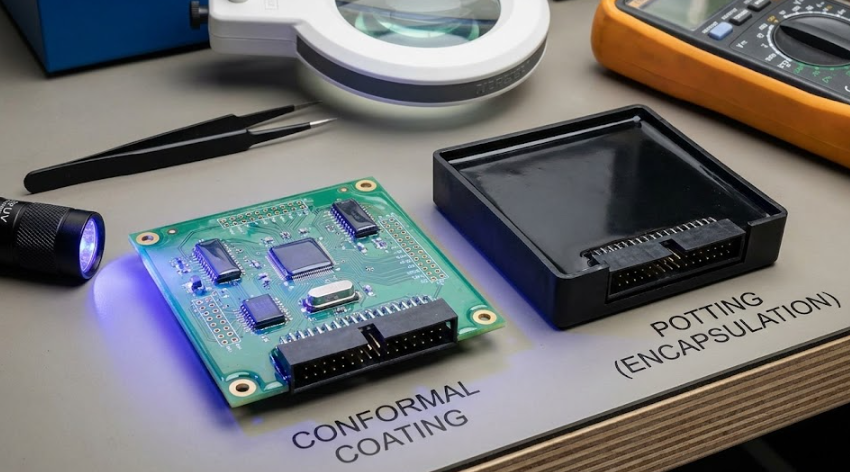
Two primary methods dominate the industry: Conformal Coating and Potting (Encapsulation). While both serve to protect, they function in fundamentally different ways. Choosing the wrong one can lead to overheating, unserviceable units, or catastrophic field failures.
Conformal coating is a thin, protective polymeric film (usually acrylic, silicone, or urethane) applied to the printed circuit board (PCB). It “conforms” to the shape of the components, covering solder joints and leads without adding significant weight or bulk.
Read more: Plasma Etching: Precision at the Microscopic Level
Potting involves placing the PCB inside a housing (shell) and pouring a liquid compound (epoxy, silicone, or polyurethane) over it until the electronics are completely submerged. The compound cures into a solid or rubber-like block.
Must Read: From Prototype to Profit: The Role of DFM
|
Feature |
Conformal Coating |
Potting (Encapsulation) |
|
Primary Defense |
Moisture, Dust, Chemicals |
Vibration, Impact, Submersion |
|
Weight Added |
Negligible |
Significant |
|
Thermal Management |
Good (Heat escapes easily) |
Varies (Can trap heat if not designed well) |
|
Reworkability |
Possible (Can be stripped) |
Difficult / Impossible |
|
Costo |
Generally Lower |
Generally Higher (Material volume) |
|
Typical Use Case |
Consumer IoT, Aerospace Dashboards |
EV Battery Controllers, Subsea Sensors |
Whether you choose coating or potting, consistency is key. Poor application can lead to air bubbles (voids) or uneven coverage, which compromises the seal and leaves the device vulnerable.
At Fenix MFG, our application processes are strictly controlled to ensure industrial-grade reliability.
Your product’s reliability is defined by its weakest link. A single corroded solder joint can bring down an entire system.
By integrating the right protection strategy early in the manufacturing process, Fenix MFG ensures that your product performs as flawlessly in the field as it did on the test bench.
Q: Can conformal coating protect against total water submersion?
A: Generally, no. Conformal coating is designed to protect against humidity, condensation, and occasional splashes. For devices that must survive underwater or high-pressure washing (IP67/IP68), Potting (Encapsulation) is the superior choice.
Q: Does potting cause electronics to overheat?
A: It can if the wrong compound is used. While potting restricts airflow, thermally conductive epoxies can actually help dissipate heat by moving it away from hot components to the housing case. Fenix engineers assist in selecting the right thermal compounds for your specific heat profile.
Q: Why is adhesion important for conformal coating?
A: If the coating does not stick effectively to the board, moisture can pool underneath it (delamination), causing corrosion faster than if there were no coating at all. This is why surface preparation is critical to maximizing bond strength.