Fenix – USA
389 Palm Coast Parkway SW
Palm Coast, FL 32137
(803) 649-1381
info@fenix-mfg.com
Fenix – DR
San Pedro Industrial Free Zone
San Pedro De Macorís, República Dominicana
(809) 529-4421
info@fenix-mfg.com
Fenix – USA
389 Palm Coast Parkway SW
Palm Coast, FL 32137
(803) 649-1381
info@fenix-mfg.com
Fenix – DR
San Pedro Industrial Free Zone
San Pedro De Macorís, República Dominicana
(809) 529-4421
info@fenix-mfg.com
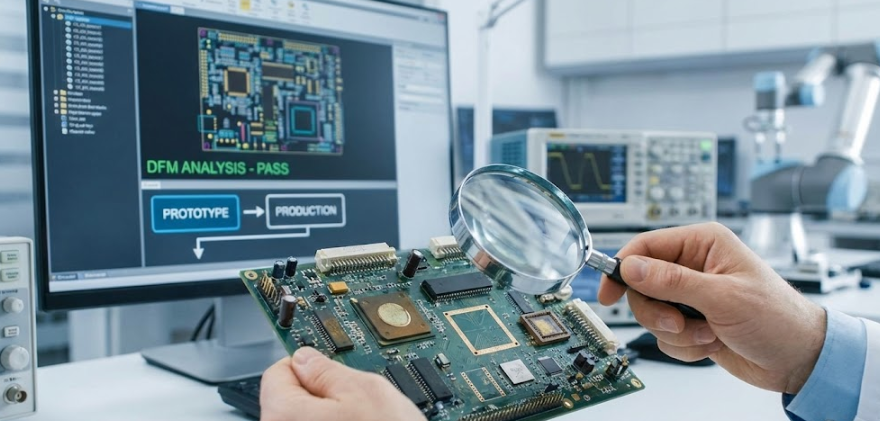
A functional prototype is a milestone, but it is not a product. In the excitement of R&D, it is easy to design a board that works perfectly on a lab bench but fails disastrously on an assembly line. As we enter 2026, the gap between “design” and “production” is widening.
Component shortages, miniaturization, and stricter reliability standards mean that the old approach – “design it, then build it” – is no longer viable.
This is where Design for Manufacturing (DFM) becomes your most valuable tool. At Fenix MFG, we don’t just build your files; we analyze them to ensure they can be manufactured efficiently, affordably, and reliably at scale.
Design for Manufacturing (DFM) is the engineering practice of designing products in such a way that they are easy to manufacture. While many engineers think of DFM as simply checking for solder bridges or trace spacing (geometry), a true DFM strategy goes much deeper. It answers three critical business questions:
The most overlooked aspect of modern DFM is component availability. You might select a high-performance chip for your prototype, only to find out it has a 50-week lead time or is nearing its End-of-Life (EOL). A robust DFM review analyzes your Bill of Materials (BOM) against global inventory data.
For consumer gadgets, a minor defect might be an annoyance. For critical sectors like Automotor or Medical Devices, it is a liability. DFM is the gatekeeper of quality. It ensures that components are placed in a way that minimizes thermal stress and vibration damage.
Related: Plasma Etching in Electronics: Precision at the Microscopic Level
Engineers design in CAD; manufacturers build with physics. A component placed too close to the edge of a PCB might look fine on a screen, but it can crack during the de-paneling process. A transformer designed without considering winding limitations might require expensive manual assembly. By engaging Fenix early, we align your design with the realities of Tecnología de montaje superficial (SMT) and automated assembly.
Deep Dive: Fine Wire Winding – The Invisible Precision
Skipping a thorough DFM review is often the most expensive decision a project manager can make. The “Rule of 10” in electronics states that the cost of fixing a defect increases by 10x at each stage of production.
The goal of 2026 is efficiency. Do not wait until your design is “frozen” to talk to your manufacturer. By integrating Design for Manufacturing early in your development cycle, you transition from a prototype that works to a product that profits.
At Fenix MFG, we are not just a factory; we are the engineering partners who ensure your vision is buildable, scalable, and resilient.
Q: At what stage should I start the DFM process?
A: Ideally, DFM should begin during the schematic design phase, before the final PCB layout is locked. Engaging Fenix MFG at this stage allows us to suggest component alternatives and layout adjustments that save significant time and money later.
Q: How does DFM improve supply chain resilience?
A: DFM involves scrubbing the Bill of Materials (BOM) to identify components that are at risk of obsolescence or have long lead times. By replacing these “high-risk” parts with widely available alternatives during the design phase, you prevent future production stoppages.
Q: What is the difference between DFA and DFM?
A: DFM (Design for Manufacturing) focuses on the fabrication of individual parts (e.g., is this PCB printable?). DFA (Design for Assembly) focuses on the process of putting those parts together (e.g., is this connector easy to plug in?). At Fenix, we combine both into a holistic DFMA approach.