Fenix – USA
389 Palm Coast Parkway SW
Palm Coast, FL 32137
(803) 649-1381
info@fenix-mfg.com
Fenix – DR
San Pedro Industrial Free Zone
San Pedro De Macoris, Dominican Republic
(809) 529-4421
info@fenix-mfg.com
Fenix – USA
389 Palm Coast Parkway SW
Palm Coast, FL 32137
(803) 649-1381
info@fenix-mfg.com
Fenix – DR
San Pedro Industrial Free Zone
San Pedro De Macoris, Dominican Republic
(809) 529-4421
info@fenix-mfg.com
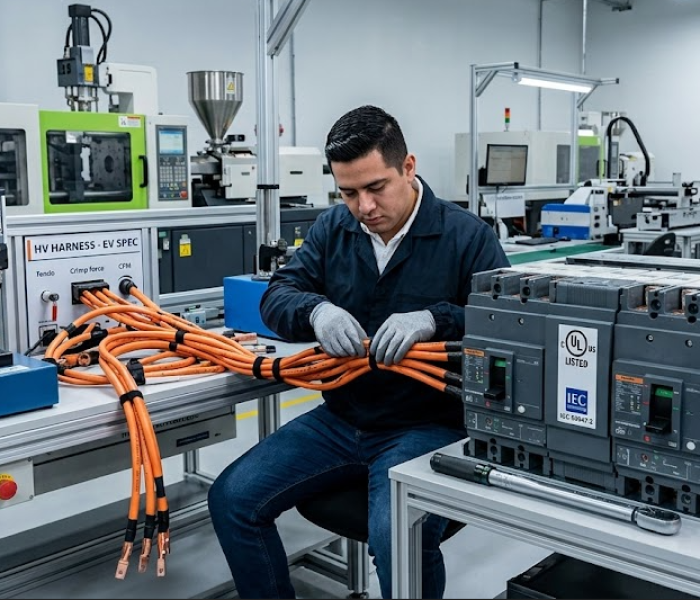
Vertical integration in heavy-duty manufacturing reduces supply chain fragmentation by consolidating critical sub-assemblies under a single quality management system. By combining high-voltage wire harnessing and circuit breaker assembly within one nearshore facility, U.S. OEMs accelerate time-to-market, eliminate multi-vendor logistical bottlenecks, and ensure uniform compliance with UL and IEC standards.
As industrial infrastructure and commercial Electric Vehicle (EV) markets expand across the United States, the engineering requirements for power distribution and interconnectivity are becoming exponentially more complex.
For North American OEMs, managing fragmented supply chains across multiple Tier 2 and Tier 3 vendors for critical power components introduces severe risks: compounded lead times, misaligned quality control protocols, and margin erosion due to redundant logistics and overseas tariffs.
To mitigate these risks, industry leaders are aggressively pursuing vertical integration. By consolidating the manufacturing of critical power delivery systems—specifically heavy-duty wire harnesses and industrial circuit breakers—into a single, highly capable nearshore facility, OEMs can reclaim control over their production timelines and quality assurance metrics.
High-voltage applications, particularly in EV charging infrastructure and heavy commercial transport, demand wire harnesses that can withstand extreme thermal cycling, vibration, and environmental degradation. Procuring these from isolated offshore vendors often leads to integration failures at the final assembly level.
Through a vertically integrated model, Fenix Manufacturing Solutions engineering teams oversee the entire lifecycle of cable assembly. This allows for rigorous, unified quality control that standalone harness shops cannot replicate. Our processes for heavy-duty applications include:
Power distribution networks require flawless circuit protection. The assembly of industrial circuit breakers requires micrometric precision in the alignment of bimetallic strips, magnetic trip coils, and arc chutes. When this assembly is outsourced to a separate vendor from the harness manufacturer, the U.S. OEM assumes the risk of mating incompatible or inconsistently tested components.
Fenix eliminates this variable by executing circuit breaker assembly adjacent to our wire harnessing lines. Operating strictly under UL 489 and IEC 60947-2 frameworks, our vertically integrated lines ensure absolute reliability:
The true value of vertical integration is amplified by geographic proximity and favorable trade economics. For engineering and procurement teams headquartered in the United States, relying on a nearshore partner in the Dominican Republic provides a distinct, quantifiable advantage across multiple industries.
Operating under the DR-CAFTA agreement, Fenix allows U.S. OEMs to bypass the severe import tariffs associated with trans-Pacific supply chains. By consolidating wire harnessing and circuit breaker assembly under one roof in the Eastern Standard Time (EST) zone, U.S.-based engineering teams can conduct synchronized, real-time quality audits.
This consolidation completely eliminates overseas freight delays, ensuring that fully tested, integrated power sub-assemblies arrive at final assembly plants in the U.S. Midwest, Texas, or the Sunbelt within predictable two-day logistical windows.
What is vertical integration in contract manufacturing?
Vertical integration is a supply chain strategy where a single manufacturing partner controls multiple, sequentially related production processes—such as wire harnessing, circuit breaker assembly, and final testing—rather than outsourcing them to disparate, fragmented vendors.
Why is Hi-Pot testing critical for circuit breaker assembly?
Hi-Pot (High Potential) testing applies a high voltage across the insulation of a circuit breaker to ensure it can safely contain and isolate electrical currents without leaking. It is a mandatory safety validation for UL and IEC compliance in heavy-duty applications.
How does DR-CAFTA benefit U.S. OEMs vertically integrating their supply chains?
The DR-CAFTA agreement eliminates import tariffs on manufactured goods entering the U.S. from the Dominican Republic. When combined with vertical integration, U.S. OEMs benefit from lower landed costs, faster EST-aligned communication, and rapid two-day shipping to domestic assembly plants.
Explore Our Capabilities:
Learn how our Wire Harnessing & Cable Assembly services deliver extreme durability, precise crimp monitoring, and environmental sealing for high-voltage industrial and EV applications.
Discover our rigorous Circuit Breaker Assembly protocols, featuring automated Hi-Pot testing and exact thermal calibration to meet strict UL 489 and IEC 60947-2 standards.
Explore the strategic advantages of Vertical Integration, and see how consolidating your fragmented supply chain into our nearshore DR-CAFTA facility can accelerate your time-to-market.