Fenix – USA
389 Palm Coast Parkway SW
Palm Coast, FL 32137
(803) 649-1381
info@fenix-mfg.com
Fenix – DR
San Pedro Industrial Free Zone
San Pedro De Macoris, Dominican Republic
(809) 529-4421
info@fenix-mfg.com
Fenix – USA
389 Palm Coast Parkway SW
Palm Coast, FL 32137
(803) 649-1381
info@fenix-mfg.com
Fenix – DR
San Pedro Industrial Free Zone
San Pedro De Macoris, Dominican Republic
(809) 529-4421
info@fenix-mfg.com
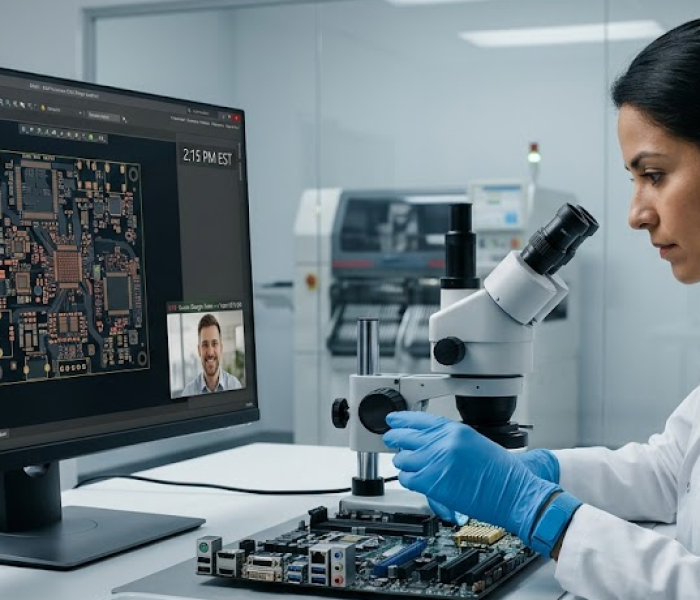
In 2026, Synchronous Engineering via nearshore partnerships is the definitive method for eliminating the 12-hour communication lag inherent in overseas electronics manufacturing. By operating in the exact same time zone as North American R&D teams, EMS providers can execute Design for Manufacturing (DFM) loops and component validations in real time, reducing the development cycle from weeks to a 48-hour CAD-to-PCBA sprint.
In the fast-moving sectors of Consumer Devices, smart utility infrastructure, and communication hardware, time-to-market dictates capital efficiency.
Traditional contract manufacturing models rely on a fragmented, asynchronous workflow: a design team in Austin, Boston, or Miami finalizes a complex CAD file and uploads it to an offshore facility located halfway across the world.
Because of the 12-hour time difference, critical engineering notes, footprint anomalies, or spacing conflicts are not reviewed until the domestic team is offline. A single clarification regarding component pitch, layer stack-up, or trace routing triggers an automatic 24-hour delay.
If a design requires three technical iterations to achieve manufacturing clearance, the project loses a full week before entering physical production. In the 2026 economic climate, this hidden operational friction represents an unacceptable drain on project ROI.
The Workflow Comparison:
The Mechanics of Synchronous DFM:
Fenix MFG eliminates the communication gap by embedding our engineering support directly into your working hours. Our technical staff doesn’t operate out of an isolated corporate headquarters; they work in a specialized production workspace separated only by a glass wall from our active, high-speed automated assembly lines and cleanrooms.
When your R&D team submits a design file, our engineers conduct an immediate review while your developers are still at their desks. If a layout modification is required to accommodate a resilient alternate component package, the changes are discussed and approved interactively.
This collaborative velocity allows us to move finalized CAD files directly to our high-precision Pick & Place robots, delivering tested, production-grade PCBA prototypes in as little as 48 hours.
This process aligns perfectly with the current 2026 industrial push—partially backed by regional supply chain security initiatives—to localize hardware validation closer to U.S. tech hubs.
Do not allow a 12-hour communication gap to delay your critical product launch window. Explore our comprehensive OEM Solutions to align your engineering workflows with same-timezone manufacturing support, or reach out to our team today to initiate an interactive design review.
Waiting for overnight feedback is an obsolete paradigm for modern technology deployment. Shifting to a synchronous, nearshore engineering model transforms your manufacturing partner into an agile, real-time extension of your internal development team.
By wiping out the 12-hour lag, you don’t just save days on the calendar; you protect your margins and accelerate your velocity to market.
Q: What technical documentation is required to initiate a synchronous nearshore DFM review?
We require complete Gerber files (RS-274X or ODB++ format), an accurate Bill of Materials (BOM) in a standardized .csv matrix, and precise coordinate pick-and-place XY data.
Q: How does same-timezone collaboration impact custom overmolding or sub-assemblies?
It ensures that spatial tolerances between the completed PCBA and custom plastic injection molded enclosures are verified concurrently, eliminating mechanical interference risks prior to production.
Q: Can Fenix perform these rapid reviews on legacy layouts?
Yes. Existing legacy boards can be reassessed to standardize component footprints and introduce elastic land patterns, making them compatible with automated assembly lines without changing the underlying circuit logic.