Fenix – USA
389 Palm Coast Parkway SW
Palm Coast, FL 32137
(803) 649-1381
info@fenix-mfg.com
Fenix – DR
San Pedro Industrial Free Zone
San Pedro De Macoris, Dominican Republic
(809) 529-4421
info@fenix-mfg.com
Fenix – USA
389 Palm Coast Parkway SW
Palm Coast, FL 32137
(803) 649-1381
info@fenix-mfg.com
Fenix – DR
San Pedro Industrial Free Zone
San Pedro De Macoris, Dominican Republic
(809) 529-4421
info@fenix-mfg.com
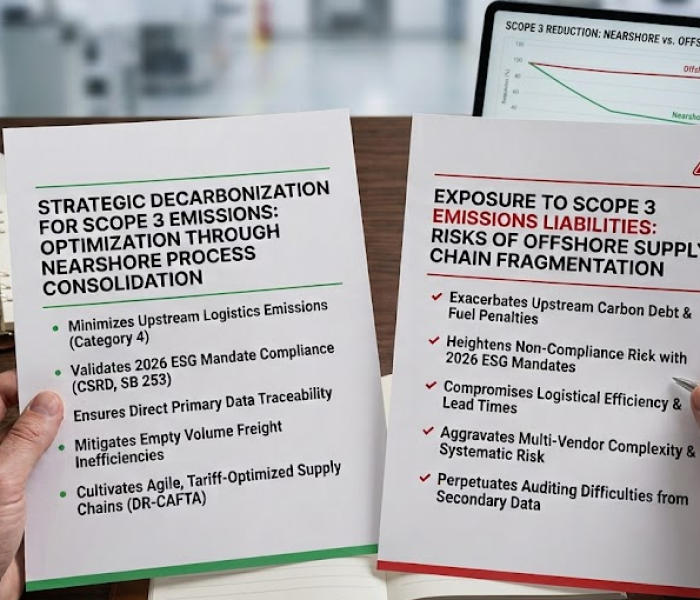
Nearshoring reduces Scope 3 supply chain emissions by eliminating high-carbon trans-Pacific ocean and air freight. By consolidating operations like Plastic Injection Molding and Electromechanical Assembly under a single facility within the DR-CAFTA zone, electronics manufacturers drastically lower upstream transportation footprints while improving data traceability for 2026 ESG reporting mandates.
As regulatory bodies globally transition from voluntary climate frameworks to mandatory reporting structures, Original Equipment Manufacturers (OEMs) face intense scrutiny over their greenhouse gas (GHG) inventories. With strict mandates like the EU’s Corporate Sustainability Reporting Directive (CSRD) and California’s SB 253 taking effect, calculating and mitigating carbon footprints is no longer an optional corporate exercise—it is a legal and commercial requirement.
For electronics manufacturers, the core of this challenge lies outside their direct control. According to the GHG Protocol, Scope 3 emissions—which cover indirect upstream and downstream value chain activities—typically account for 70% to 90% of a company’s total carbon footprint.
Attempting to hit 2026 ESG targets while relying on a highly fragmented, trans-Pacific supply chain is mathematically unsustainable. Reclaiming control requires structural Supply Chain Management shifts, specifically through nearshoring and process consolidation.
Under the GHG Protocol, Scope 3 is divided into 15 categories, with Category 4 (Upstream Transportation and Distribution) representing a critical vulnerability for North American OEMs. The physics of moving heavy electromechanical infrastructure across the globe requires burning massive volumes of highly carbon-intensive bunker fuel.
Consider the baseline logistics of offshore manufacturing. Shipping a container of assembled electronics from Shenzhen, China, to a port in California covers roughly 6,500 nautical miles. If the OEM requires expedited air freight to bypass ocean delays, the emissions multiplier increases exponentially.
By contrast, the nearshore model utilizes the geographic proximity of the Dominican Republic. Shipping from the DR-CAFTA zone to Miami, Florida, covers less than 1,000 nautical miles via short-sea shipping routes. This physical reduction in transit distance yields an immediate, quantifiable drop in Category 4 Scope 3 emissions, allowing OEMs to lock in permanent carbon reductions at the logistical baseline.
Transportation distance is only half the equation; the efficiency of what is being transported dictates the rest. One of the most severe logistical inefficiencies in electronics manufacturing is the transportation of isolated structural components, particularly mechanical housings.
When an OEM contracts an Asian facility exclusively for Plastic Injection Molding, they are effectively paying to ship empty air across the ocean. High-volume, low-density plastic enclosures occupy massive container space while contributing very little to the actual functional value of the shipment during transit.
Nearshoring resolves this “empty volume” penalty through vertical integration. By executing Plastic Injection Molding under the same roof as PCB Assembly and final Electromechanical Assembly, the empty housing is immediately populated with high-density electronics before it ever enters a shipping container.
The Dominican Republic facility receives raw, high-performance resins in dense, bulk formats, molding them only at the point of final assembly. This consolidation maximizes the carbon-efficiency of every cubic meter shipped northward, drastically lowering the embodied transportation carbon per unit.
Fragmented supply chains actively multiply Scope 3 emissions by forcing sub-assemblies to travel between multiple intermediary nodes. If a bare board is fabricated in Taiwan, populated with SMT components in Malaysia, shipped to Mexico for Wire Harness integration, and finally moved to the US for testing, the OEM accumulates a massive Category 1 (Purchased Goods and Services) and Category 4 carbon debt before the product is even sold.
A unified nearshore Supply Chain Management strategy collapses these nodes. Executing the entire build—from circuit breaker integration to final box build—within a single ISO 9001:2015 certified facility in the DR-CAFTA zone eliminates the redundant transit loops.
Furthermore, this localized approach provides the precise primary data required for stringent 2026 ESG audits. Instead of relying on vague, secondary industry averages to calculate carbon footprints, OEMs can trace the exact logistical and operational footprint of their product from a single, transparent partner.
By physically shortening the supply chain and consolidating manufacturing disciplines, nearshoring transforms Scope 3 compliance from an accounting liability into an engineered advantage.
Scope 3 emissions represent all indirect greenhouse gas emissions that occur in a company’s value chain, excluding direct operations and purchased electricity. For electronics OEMs, this spans 15 categories, including raw material sourcing, purchased goods and services (Category 1), and upstream transportation (Category 4). Scope 3 routinely accounts for 70% to 90% of an electronics firm’s total carbon footprint.
Category 4 governs upstream transportation and distribution. Nearshoring from the Dominican Republic to the United States replaces 6,500-nautical-mile trans-Pacific ocean freight with sub-1,000-mile short-sea logistics. This drastically reduces the volume of heavy bunker fuel burned per shipment, immediately lowering the transportation carbon footprint.
Shipping empty plastic housings from offshore suppliers is highly carbon-inefficient because containers are filled mostly with air. By consolidating Plastic Injection Molding with final electromechanical assembly in a nearshore facility, OEMs import dense, raw resins and only ship fully integrated, high-density finished products, optimizing the carbon-to-volume ratio of freight.
Regulatory mandates in 2026 require accurate, audit-ready primary data regarding supply chain emissions. Operating within the DR-CAFTA framework encourages OEMs to consolidate multi-node supply chains into a single nearshore facility. This eliminates the data inconsistencies caused by tracking sub-assemblies across dozens of isolated global vendors, simplifying ESG reporting.
As 2026 ESG mandates reshape global commerce, reducing Scope 3 emissions is no longer a peripheral sustainability goal; it is a rigid prerequisite for market access and financial viability.
Relying on fragmented, trans-Pacific manufacturing models ensures that an OEM’s carbon footprint will remain heavily burdened by massive upstream transportation and inefficient logistics.
By transitioning production to an advanced nearshore EMS partner in the Dominican Republic, electronics developers can engineer their way out of this carbon deficit. Consolidating critical processes—such as high-precision plastic injection molding, wire harnessing, and electromechanical assembly—under a unified roof eliminates redundant transit nodes and maximizes the carbon efficiency of every shipment.
Shielded by the DR-CAFTA framework, this strategy not only secures robust supply chain agility but provides the exact, verifiable footprint reduction required to lead in the modern regulatory landscape.