FDA QMSR Harmonization: Navigating the 2026 Medical Device Manufacturing Landscape

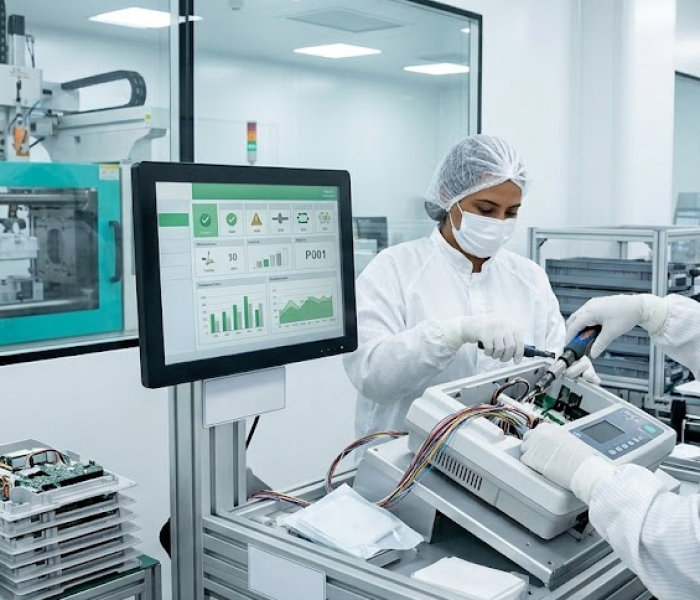
Two manufacturing engineers in ESD-safe cleanroom garments perform precision electromechanical assembly on a medical device. A digital quality control screen is visible at the workstation, while a plastic injection molding machine operates in the background within an ISO-certified facility.

The 2026 FDA Quality Management System Regulation (QMSR) impacts medical device contract manufacturing by directly aligning US federal requirements with the global ISO 13485 standard.

This transition mandates that contract manufacturing partners enforce unified risk management frameworks, comprehensive lifecycle traceability, and stricter intellectual property protections across all production phases.

The 2026 regulatory environment for life sciences hardware is defined by a fundamental structural shift. The FDA’s transition to the Quality Management System Regulation (QMSR)—harmonizing the legacy 21 CFR Part 820 with the international ISO 13485 standard—establishes a stringent, unified baseline for medical device production. For North American OEMs, navigating this regulatory alignment requires a critical audit of their existing supply chains.

Relying on offshore partners with fragmented compliance frameworks or opaque quality management systems now introduces unacceptable regulatory delays and intellectual property (IP) vulnerabilities.

To mitigate these risks, OEMs are strategically nearshoring production to highly regulated, ISO-certified facilities within the DR-CAFTA region, ensuring absolute compliance and data security.

Securing Intellectual Property in the DR-CAFTA Framework

Transferring proprietary schematics, firmware, and tooling designs to a medical device contract manufacturer requires an environment of absolute security. In distant offshore facilities, IP enforcement can be notoriously difficult, increasing the risk of counterfeiting or unauthorized gray-market production of sensitive life sciences technology.

Nearshoring to the Dominican Republic neutralizes this threat. Operating under the robust legal protections of the DR-CAFTA framework, Fenix Manufacturing Solutions provides a secure haven for OEM intellectual property.

By maintaining production in San Pedro de Macorís, Fenix ensures that all proprietary data remains within a legally bound, highly regulated environment. This physical and digital security is coupled with strict Device History Record (DHR) protocols, ensuring that every component, from microprocessors to molded housings, is meticulously tracked.

Compliance-Driven Electromechanical Assembly

The FDA QMSR harmonization places intense regulatory scrutiny on risk management during the physical integration of medical devices. Diagnostic equipment, patient monitoring systems, and surgical robotics require flawless execution where failure is not an option.

Fenix executes advanced Electromechanical Assembly under strict ISO-aligned protocols. To meet the rigorous demands of the QMSR framework, our assembly lines feature:

  • Torque and Force Calibration: All pneumatic and electronic fastening tools are strictly calibrated and logged, ensuring physical integrations meet exact engineering tolerances without inducing stress fractures in sensitive components.

  • ESD-Safe Environments: Total electrostatic discharge (ESD) mitigation is enforced across the assembly floor to protect proprietary diagnostic sensors and medical PCBAs from latent static damage.

  • Component-Level Traceability: Every sub-assembly is barcoded and logged into a unified quality management system, providing FDA auditors with an unbroken chain of custody.

Precision Traceability in Plastic Injection Molding

Medical-grade enclosures, fluid-path components, and structural housings must adhere strictly to biocompatibility standards (such as ISO 10993) and exact geometric tolerances. Under QMSR, the burden of proof for material consistency rests heavily on the manufacturer.

Fenix mitigates this regulatory burden by applying scientific molding principles to our Plastic Injection Molding operations. Cavity pressure monitoring and precise thermodynamic control loops prevent warp, sink marks, or dimensional deviations. More importantly, automated resin lot tracking ensures that every molded component is fully traceable back to its specific raw material batch, perfectly aligning with the strict documentation requirements of an ISO 13485 and FDA QMSR audit.

Frequently Asked Questions: FDA QMSR and Medical Manufacturing

What is FDA QMSR harmonization?

FDA QMSR harmonization is the 2026 regulatory shift where the US Food and Drug Administration aligns its current Good Manufacturing Practice (cGMP) requirements (21 CFR Part 820) with the international consensus standard for medical devices, ISO 13485.

Why is IP protection critical when choosing a medical device contract manufacturer?

Medical devices rely on highly proprietary sensor technology, firmware, and patented mechanical designs. Choosing a manufacturing partner in a legally secure framework like DR-CAFTA prevents unauthorized reproduction and protects the massive R&D investments required for life sciences hardware.

How does nearshoring improve FDA QMSR compliance?

Nearshoring in the EST time zone allows for synchronous quality audits and real-time collaboration between the OEM’s regulatory team and the manufacturing floor. This proximity ensures that risk management protocols and Device History Records (DHR) are managed transparently and without the delays caused by trans-Pacific communication.

Explore Our Capabilities:

en_USEN