Fenix – USA
389 Palm Coast Parkway SW
Palm Coast, FL 32137
(803) 649-1381
info@fenix-mfg.com
Fenix – DR
San Pedro Industrial Free Zone
San Pedro De Macoris, Dominican Republic
(809) 529-4421
info@fenix-mfg.com
Fenix – USA
389 Palm Coast Parkway SW
Palm Coast, FL 32137
(803) 649-1381
info@fenix-mfg.com
Fenix – DR
San Pedro Industrial Free Zone
San Pedro De Macoris, Dominican Republic
(809) 529-4421
info@fenix-mfg.com
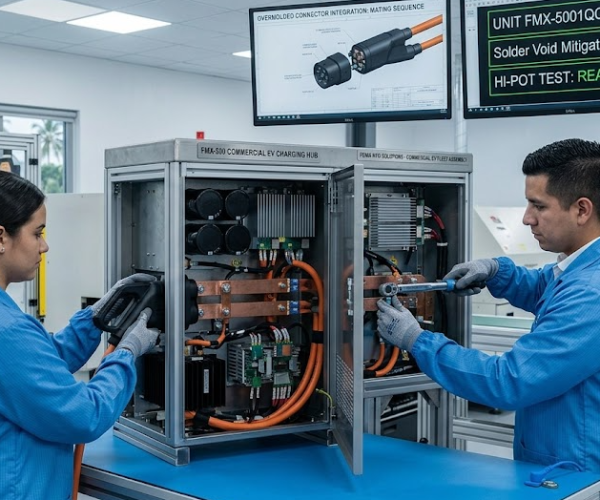
Commercial EV assembly requires extreme durability to withstand the physical and thermal demands of heavy-duty fleet operations. Manufacturing these systems involves precision plastic injection molding for ruggedized connectors and complex electromechanical assembly for fleet charging hubs. By nearshoring these processes to the DR-CAFTA region, U.S. OEMs ensure strict quality compliance while bypassing restrictive 2026 supply chain tariffs.
The transition to commercial Electric Vehicle (EV) fleets is accelerating, placing unprecedented demands on North American automotive infrastructure.
Unlike consumer vehicles, commercial EV trucks, transit buses, and fleet charging hubs operate under continuous, high-stress conditions. This requires automotive components that are engineered for heavy-duty thermal cycling, constant vibration, and environmental exposure.
Simultaneously, the financial landscape of automotive manufacturing has fundamentally shifted. With aggressive 2026 tariffs impacting Asian and certain North American trade corridors, relying on legacy supply chains has become a margin-eroding liability.
To secure their operations, leading U.S. OEMs are utilizing the Dominican Republic (DR-CAFTA) as a strategic financial shield, nearshoring critical commercial EV assembly to ensure duty-free market access and rapid two-day logistics.
The structural integrity of commercial EV infrastructure relies heavily on advanced polymers. From high-voltage battery enclosures to ruggedized charging connectors, these components must survive extreme environments without degrading.
By leveraging nearshore Plastic Injection Molding, U.S. engineering teams can oversee the production of complex, heavy-duty automotive plastics in the same time zone (EST). Key manufacturing standards include:
Scaling commercial EV fleets requires a massive rollout of decentralized, heavy-duty charging hubs. The electromechanical assembly of these stations involves integrating high-voltage power routing with delicate digital communication boards that handshake with the vehicle.
Consolidating this assembly in a highly regulated DR-CAFTA facility allows OEMs to merge their mechanical hardware and PCBA sub-assemblies under a single, unified quality management system.
This eliminates the risk of mating incompatible components from fragmented offshore vendors, ensuring that fully assembled charging modules arrive at U.S. deployment sites tested, certified, and ready for immediate installation.
How does DR-CAFTA protect commercial EV supply chains from 2026 tariffs?
The DR-CAFTA agreement provides a vital “safety valve” by allowing manufactured goods, including heavy-duty automotive assemblies and plastics, to enter the United States duty-free. This legally shields U.S. OEMs from the high tariffs recently imposed on components originating from non-FTA Asian countries.
Why is overmolding critical for commercial EV connectors?
Overmolding encapsulates wire terminations and metal inserts within a seamless plastic polymer. For commercial EV fleets exposed to rain, snow, and corrosive road salts, this creates an impenetrable environmental seal that prevents catastrophic electrical shorts.
What is the logistical advantage of nearshoring EV assembly to the Dominican Republic?
Beyond tariff avoidance, the DR-CAFTA region operates in the EST time zone and offers rapid freight routes. Fully integrated electromechanical assemblies can reach U.S. ports (like Miami or New York) in two to four days, drastically reducing inventory holding costs compared to 40-day trans-Pacific shipments.
Explore Our Capabilities: