Beyond the Board: The Strategic Value of Box Build Assembly

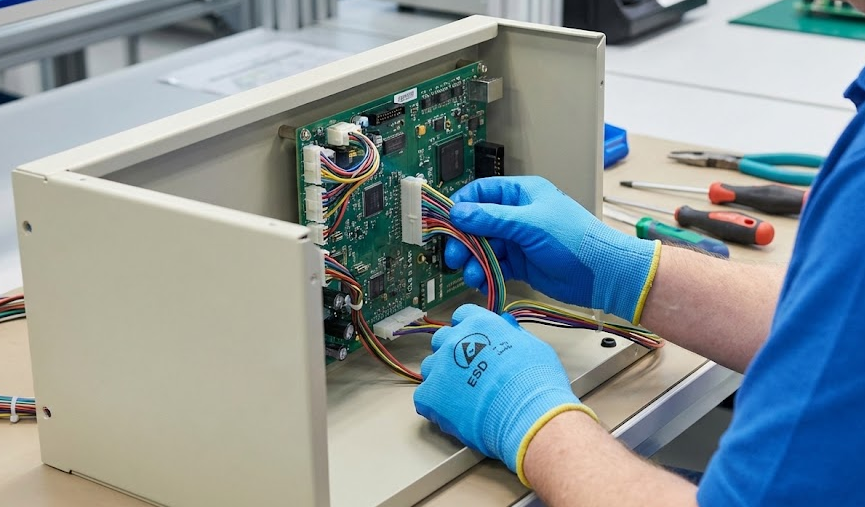
Technician with ESD gloves performing box build assembly, connecting a wire harness to a PCB inside a metal enclosure.

You don’t sell circuit boards to your customers. You sell finished products.

So why are you still managing your supply chain like a puzzle?

Many OEMs source their PCBs from Supplier A, their cable assemblies from Supplier B, and their plastic enclosures from Supplier C, only to assemble everything in-house (or at a fourth location).

This fragmented approach introduces three silent killers to your business: Logistics Costs, Communication Delays, and the dreaded “Blame Game” when parts don’t fit together.

At Fenix MFG, we offer a smarter alternative: Box Build Assembly. We take the high-precision electronics we manufacture and integrate them into the final mechanical housing, delivering a fully tested, ready-to-ship unit.

What is Box Build Assembly?

Often called “Systems Integration,” a Box Build can range from a simple PCB inside a plastic case to a complex electromechanical machine involving pneumatics, displays, and thermal management.

It is the process where electronics meet physics.

  • The Core: Installing the PCBA (Printed Circuit Board Assembly).
  • The Veins: Routing custom Wire Harnesses and cabling.
  • The Body: Sub-assembly installation into metal or plastic enclosures.
  • The Shield: Application of potting or conformal coating for protection.

Related: Conformal Coating vs. Potting for Harsh Environments

The "One PO" Advantage (Supply Chain Consolidation)

The biggest argument for moving to a Box Build model is Accountability.

When Fenix manages the entire build, you have one Point of Contact and one Purchase Order (PO).

  • Eliminate Finger-Pointing: If a connector doesn’t fit the port, we don’t call the cable vendor to complain. We are the cable vendor. We solve the tolerance issue immediately on the line.
  • Reduce Freight: Instead of shipping components to three different locations, you ship raw materials to the Dominican Republic and receive finished goods at your distribution center.

Specialized Capabilities: High-Reliability Integration

Box Build is not just about screwing a lid onto a box. For sectors like Automotive and Industrial Controls, it requires engineering rigor.

  • Automotive Ruggedization: We understand how to route cables to prevent vibration fatigue and how to apply torque specifications that ensure fasteners never loosen in the field.
  • Thermal Management: We apply thermal pastes and pads accurately to ensure heat sinks make perfect contact with processors, preventing overheating in enclosed spaces.

The Final Gate: Functional Testing

When you buy a bare PCB, you test the circuit. When you buy a Box Build, you test the function.

Because we control the final assembly, we can perform Functional Verification Testing (FVT) on the completed unit.

  • Does the screen light up?
  • Do the buttons respond?

Does the unit communicate with the cloud?
We ensure that “Dead on Arrival” (DOA) units are filtered out before they ever leave our dock.

Conclusion: From Component Buyer to Strategic Partner

The shift from buying parts to buying solutions is how modern OEMs scale.

By trusting Fenix MFG with your Electromechanical Assembly, you free up your internal resources to focus on what matters most: innovation and sales. Let us handle the nuts, bolts, and wires.

FAQ: Box Build Services

Q: What information does Fenix need to quote a Box Build?

A: In addition to the BOM and Gerber files for the PCB, we need 3D CAD models of the assembly, a detailed Bill of Materials for mechanical parts (screws, washers, labels), and clear Assembly Instructions (drawings or SOPs).

Q: Can Fenix source the mechanical enclosures?

A: Yes. We work with a network of trusted suppliers for plastic injection molding and sheet metal fabrication. We can source the custom housings and manage the inventory for you.

Q: Is Box Build assembly expensive?

A: While the unit price is higher than a bare board, the Total Landed Cost is often lower. You save on internal labor, reduced shipping fees, simpler inventory management, and lower administrative overhead (fewer vendors to manage).

en_USEN