Fenix – USA
389 Palm Coast Parkway SW
Palm Coast, FL 32137
(803) 649-1381
info@fenix-mfg.com
Fenix – DR
San Pedro Industrial Free Zone
San Pedro De Macoris, Dominican Republic
(809) 529-4421
info@fenix-mfg.com
Fenix – USA
389 Palm Coast Parkway SW
Palm Coast, FL 32137
(803) 649-1381
info@fenix-mfg.com
Fenix – DR
San Pedro Industrial Free Zone
San Pedro De Macoris, Dominican Republic
(809) 529-4421
info@fenix-mfg.com
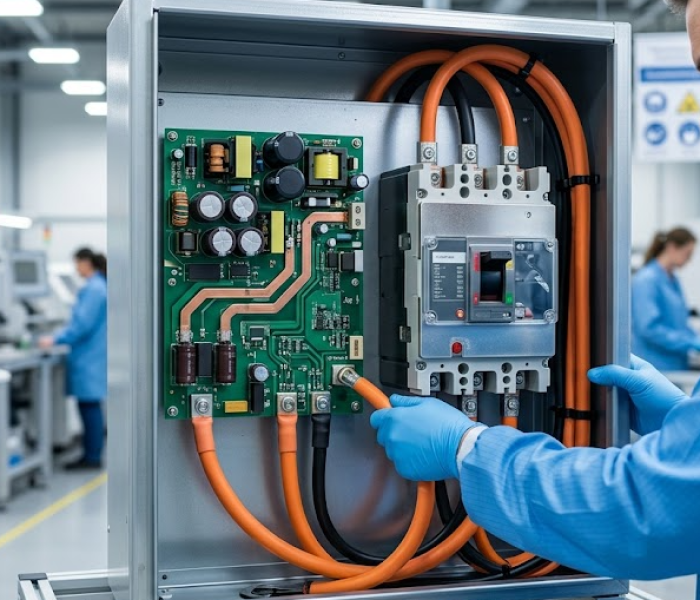
An Original Equipment Manufacturer (OEM) retains product IP and brand ownership, while Tier 1 manufacturers supply fully integrated subsystems directly to them, and Tier 2 firms provide localized components to Tier 1s.
For fast-evolving IoT hardware, agile nearshore EMS providers operating at a Tier 2 precision level offer superior engineering flexibility, same-timezone Design for Manufacturing (DFM) collaboration, and scalable production runs compared to rigid, high-volume offshore Tier 1 mass production.
The global electronics supply chain is undergoing a profound structural realignment. As engineering lifecycles compress and hardware requires continuous, iterative hardware and firmware updates, traditional reliance on massive, trans-Pacific manufacturing conglomerates is revealing severe operational bottlenecks.
For engineering and procurement executives developing hardware within the Internet of Things (IoT) and telecommunications sectors, deciphering the technical and logistical boundaries of the classical tiered manufacturing framework is no longer just an administrative task—it is a core architectural decision.
To optimize a hardware deployment, supply chain leaders must precisely delineate where intellectual property ownership, operational assembly complexity, and component sourcing responsibility reside within the ecosystem.
The OEM (Original Equipment Manufacturer):
The OEM is the ultimate architect and intellectual property owner. Whether developing an industrial IoT gateway, a smart utility monitor, or an Open RAN radio unit, the OEM controls the functional specifications, source firmware, and overarching commercial brand.
The Tier 1 Manufacturer:
Tier 1 contract manufacturers are global conglomerates optimized for monolithic, hyper-volume production runs. They typically deliver fully integrated systems or massive structural subsystems directly to the OEM.
However, their factory infrastructure is inherently rigid, requiring immense Minimum Order Quantities (MOQs) and lengthy tooling set-up phases to justify manufacturing floor allocation.
The Tier 2 Supplier:
Tier 2 manufacturers focus on high-precision foundational operations—such as complex Printed Circuit Board Assembly (PCBA), Surface Mount Technology (SMT) line management, and specialized electromechanical sub-assemblies.
They supply these critical modules to Tier 1 integrators or partner directly with agile OEMs who choose to manage their own final box-build integration.
For standardized consumer electronics with multi-year product lifecycles, the rigid, high-volume Tier 1 model remains financially viable.
However, modern IoT infrastructure demands a level of physical and electrical agility that trans-Pacific Tier 1 factories are simply not instrumented to provide smoothly.
When an IoT developer needs to execute a critical component substitution—such as swapping an allocated microcontroller or adjusting an antenna array configuration to optimize radio frequency (RF) signal integrity—the offshore Tier 1 ecosystem introduces a costly 12-hour communication lag.
An engineering change order (ECO) issued by a North American team sits idle overnight, delaying crucial Design for Manufacturing (DFM) verification. Combined with weeks of ocean freight, a single unoptimized board layout can stall a product launch by months.
Furthermore, Tier 1 manufacturing lines utilize ultra-high-speed Pick-and-Place systems calibrated for millions of identical units.
Forcing an engineering pause on these massive lines to run a specialized batch of 5,000 smart infrastructure sensors is structurally inefficient, resulting in prohibitive setup penalties or outright production rejection.
To bypass the structural rigidity of offshore Tier 1 giants, forward-thinking OEMs are shifting production directly to advanced nearshore EMS providers in the Dominican Republic. This tactical move transforms a rigid, multi-layered supplier tier into an agile, collaborative engineering workflow.
Operating within the same time zone (EST) fundamentally changes the dynamics of PCB Assembly (PCBA). When an OEM engineering team adjusts a high-density, multi-layer circuit board layout, the nearshore SMT engineering team can perform real-time automated optical inspection (AOI) data review and solder paste stencil optimization concurrently. Rather than waiting days for a prototype run, the nearshore facility can execute high-speed component placement down to 0201 metric footprints and pass the assemblies through multi-zone reflow ovens within hours.
A common misconception is that shifting away from global Tier 1 integrators requires compromising on quality standards. High-tier nearshore electronics manufacturing is grounded in strict technical governance, adhering strictly to:
By utilizing nearshore contract manufacturing within the DR-CAFTA framework, North American OEMs secure duty-free access to high-reliability components without losing ownership of their production timelines.
The result is a highly responsive supply chain capable of delivering rapid PCBA iterations, allowing mid-tier and enterprise OEMs alike to scale hardware at the speed of software.
An OEM (Original Equipment Manufacturer) owns the intellectual property, design, firmware, and brand of the product. A Tier 1 manufacturer is a contract electronics supplier that builds and delivers massive, fully integrated subsystems or final products directly to the OEM, typically requiring high volumes to justify production line setups.
Offshore Tier 1 facilities are optimized for rigid, multi-million-unit production runs. For fast-evolving IoT infrastructure, these models introduce critical friction points, including a 12-hour communication lag for Engineering Change Orders (ECOs), long trans-Pacific transit times, and high Minimum Order Quantities (MOQs) that reject small, iterative hardware optimizations.
Partnering with a nearshore contract manufacturer operating at a Tier 2 precision level allows for synchronous engineering. Sharing the Eastern Standard Time (EST) zone allows North American OEMs to collaborate on Design for Manufacturing (DFM) adjustments in real-time, executing high-speed SMT placement, reflow soldering, and automated optical inspection (AOI) within the same business day.
A qualified nearshore EMS provider maintains strict technical governance identical to global networks. High-reliability electronics are secured through compliance with IPC-A-610 Class 3 standards for high-performance electronic assemblies and rigorous ISO 9001:2015 data-driven quality management systems.
The historical paradigm of outsourcing electronic hardware exclusively to massive, rigid offshore Tier 1 networks is no longer sustainable for agile IoT and telecommunications infrastructure.
Forcing highly iterative, specialized designs into manufacturing ecosystems optimized only for monolithic mass production leads to delayed product rollouts, communication bottlenecks, and fragile supply chains.
By shifting production directly to an advanced nearshore EMS partner in the Dominican Republic, North American OEMs effectively eliminate the multi-layered overhead and rigid constraints of traditional tier structures.
This strategic transition provides immediate access to high-speed SMT lines, automated quality testing, and robust electromechanical integration—all executed in real-time synchronization with domestic R&D teams.
Under the duty-free protection of the DR-CAFTA framework, nearshoring redefines the supply chain, transforming hardware manufacturing from a logistical hurdle into an agile competitive advantage.