The 50% Spike: Design for Resilience (DfR) in a Volatile 2026

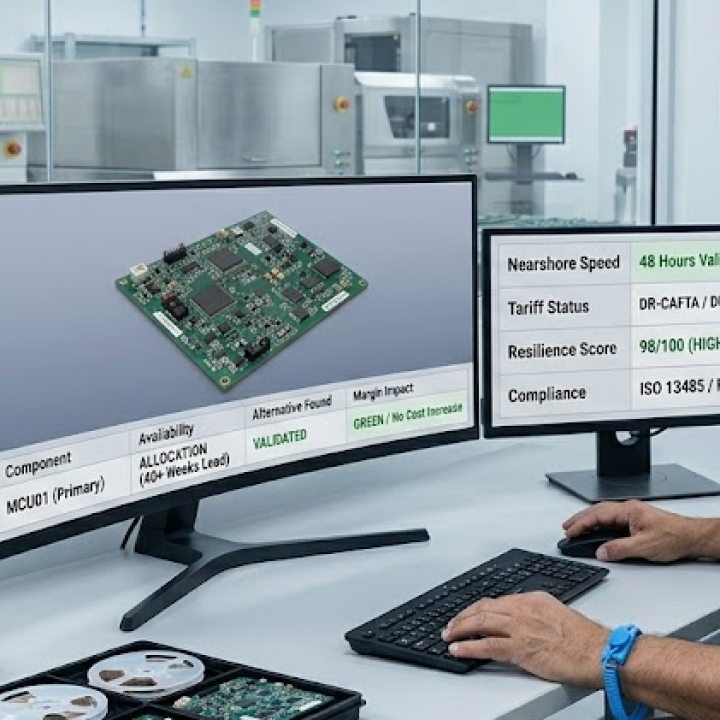
A Fenix MFG strategic sourcing lead in a production-view office validating a PCBA redesign. Dual monitors display a 3D board model with component substitution and an executive dashboard showing DR-CAFTA duty-free status, ISO 13485 compliance, and a high supply chain resilience score.

The Educational Deep-Dive: Understanding DfR

The electronics landscape of May 2026 is defined by “The 50% Spike.” After a brief stabilization, semiconductor lead times nearly doubled between February and March of this year. Data shows price increases of 15% to 85% across major mature-node chipsets.

In this environment, traditional Design for Manufacturing (DFM) is no longer enough; it assumes parts are available. Today, you must adopt Design for Resilience (DfR).

What is DfR?

DfR treats supply chain volatility as a core design constraint. It is the practice of engineering a PCBA to survive the sudden disappearance of a primary component without stalling production.

The Technical Core of 2026 Resilience:

  • Elastic Footprints: Designing universal land patterns that accept multiple package sizes (e.g., a pad layout compatible with both 0402 and 0603 passives).
  • Pin-Compatible MCUs: Selecting microcontrollers with “drop-in” alternates from secondary vendors to avoid a full firmware and layout overhaul.
  • Firmware Abstraction: Implementing Hardware Abstraction Layers (HAL) so that software can migrate to alternate chipsets with minimal engineering hours.

In 2026, Design for Resilience (DfR) is the primary strategy for mitigating PCBA component shortages. Following the March 2026 lead-time surge (where wait times for critical power ICs and MCUs exceeded 40 weeks) OEMs are prioritizing Nearshore Synchronous Engineering.

This model enables rapid component substitution and board redesigns within 48 hours, leveraging DR-CAFTA for duty-free stability and bypassing the 12-hour communication lag of overseas suppliers.

The Fenix Logic: Nearshore Velocity as a Shield

At Fenix MFG, we recognize that a redesign is only as fast as the communication loop. In the “old” offshore model, a single component swap requires 5–7 days of overnight emails due to the 12-hour time difference.

By the time the redesign is approved, the available “buffer stock” of alternates has often been purchased by a competitor.

The Fenix Nearshore Advantage:

  • Zero-Hour Lag: Our engineering team works in your time zone. We provide Synchronous DfR feedback while your team is still at their desks.
  • Strategic Sourcing Audits: Our procurement experts review your BOM (Bill of Materials) during the design phase to identify “at-risk” components before they hit allocation.
  • 48-Hour Prototyping: Once a resilient redesign is finalized, our dedicated SMT lines produce a tested, production-grade prototype in 48 hours.
  • DR-CAFTA Stability: Every redesign remains duty-free under DR-CAFTA, protecting your margins from the 2026 trade turbulence affecting Mexico and Asian manufacturing hubs.

Conclusion: From Reactive to Proactive

The 2026 shortage isn’t a temporary hurdle; it’s the new baseline. Relying on 40-day sea freight for boards that might need a redesign mid-transit is no longer viable.

By shifting to Design for Resilience and a Nearshore model, Fenix MFG helps you turn supply chain volatility into a speed-to-market advantage.

Navigate the 2026 component crisis with a partner that integrates design and production. Explore our Supply Chain Management Solutions for strategic sourcing or contact us for an OEM Solutions consultation to audit your legacy designs for resilience.

Technical FAQ: Resilience & Nearshoring

Q: Does DfR increase the initial cost of the PCBA?

While routing may be slightly more complex, the cost is offset by avoiding production halts. A resilient design ensures a $0.50 part shortage doesn’t stop a $500 finished product.

Q: How does Fenix help with component substitution?

Our Strategic Sourcing team reviews your BOM to identify at-risk parts and suggests functionally equivalent alternates based on real-time market availability.

Q: Can I modify my existing legacy boards?

Yes. We offer DfR Audits for legacy designs, identifying where minor pad modifications can unlock multiple sourcing options for future production runs.

en_USEN