Fenix – USA
389 Palm Coast Parkway SW
Palm Coast, FL 32137
(803) 649-1381
info@fenix-mfg.com
Fenix – DR
San Pedro Industrial Free Zone
San Pedro De Macoris, Dominican Republic
(809) 529-4421
info@fenix-mfg.com
Fenix – USA
389 Palm Coast Parkway SW
Palm Coast, FL 32137
(803) 649-1381
info@fenix-mfg.com
Fenix – DR
San Pedro Industrial Free Zone
San Pedro De Macoris, Dominican Republic
(809) 529-4421
info@fenix-mfg.com
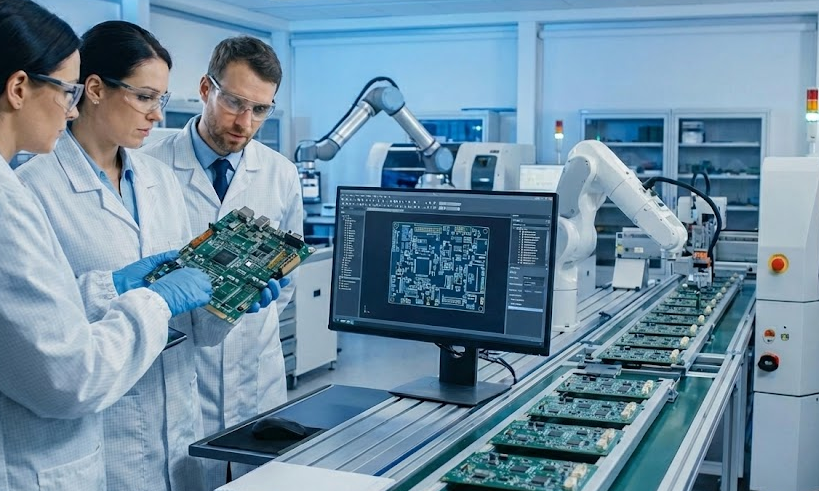
Great products don’t just happen. They are engineered to happen.
In electronics manufacturing, the most dangerous phase is not R&D, and it isn’t mass production. It is the messy middle ground between the two: New Product Introduction (NPI).
This is the “Valley of Death” for many hardware startups and established OEMs alike. It is where design flaws are exposed, supply chains break, and launch dates slip.
At Fenix MFG, we view NPI not as a hurdle, but as a strategic discipline. It is the roadmap that ensures your product is not just “buildable” once, but strictly reproducible thousands of times at the right cost.
The NPI process begins long before the first line of code is flashed or the first solder paste is printed. It starts with a comprehensive review of your data package.
This is where our Design for Manufacturing (DFM) analysis comes into play. We look for the “hidden killers” of production:
Deep Dive: Why DFM is the First Step to Supply Chain Resilience
Once the design is validated, we don’t just hit “print.” We build the manufacturing “recipe.”
This involves programming the Surface Mount Technology (SMT) lines, designing custom reflow profiles, and creating specific work instructions for operators.
This is the “dress rehearsal.” We run a small batch (Engineering Validation Test) using the exact production processes we defined.
The goal is not perfection; the goal is data.
We use this data to refine the process. If a component shifted during reflow, we adjust the thermal profile. If a cable was too tight, we update the cut length.
Only when the process is stable do we unlock the gates to mass production (PVT).
For our automotive and industrial clients, this often culminates in a PPAP (Production Part Approval Process) submission, proving that Fenix can meet the manufacturing requirements consistently at the quoted production rate.
The biggest cause of NPI failure is fragmentation: when the PCB house doesn’t talk to the cable supplier, who doesn’t talk to the assembly team.
Fenix MFG handles the entire ecosystem. Because we control the PCB assembly, the wire harness manufacturing, and the final mechanical assembly (Box Build), we solve integration issues in real-time, under one roof.
Slowing down to get the NPI process right actually makes you faster.
By investing time in the NPI phase to validate the design and the supply chain, you eliminate the frantic “fire-fighting” that plagues poorly planned launches.
Your goal is to get to market. Our job is to make sure you stay there.
Q: What is the difference between a Prototype and NPI?
A: A prototype proves the design works (proof of concept). NPI (New Product Introduction) proves the manufacturing process works. NPI focuses on scalability, cost, and repeatability, ensuring you can build thousands of units with the same quality as the first one.
Q: How long does the NPI process take?
A: It depends on product complexity, but a typical NPI cycle (from data review to mass production approval) can take anywhere from 4 to 12 weeks. Engaging your manufacturer early (during the design phase) significantly shortens this timeline.
Q: Does Fenix handle component sourcing during NPI?
A: Yes. We scrub the Bill of Materials (BOM) to identify long-lead-time parts and suggest available alternatives. This prevents supply chain surprises from stalling the launch.